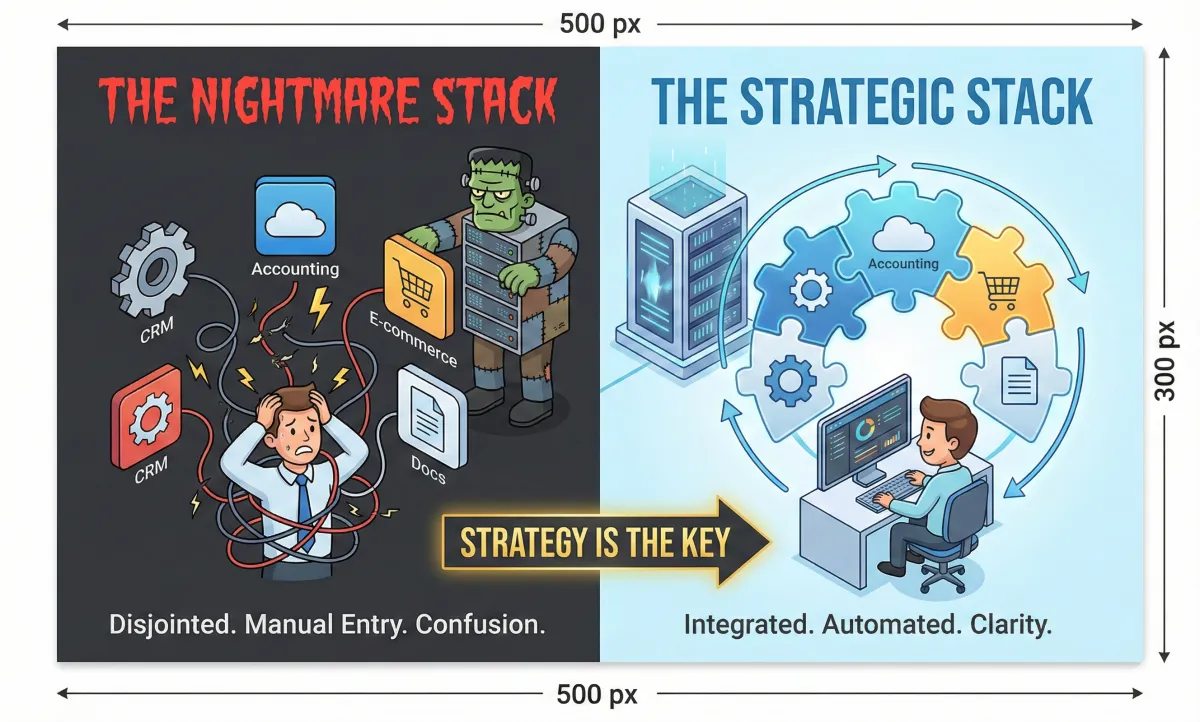
Is Your Business Tech Stack a Dream Team or a Recurring Nightmare? A Strategic Guide to Choosing Software
Let’s be real for a minute.
How many browser tabs do you have open right now related to running your business?
How many different logins do you need just to get a customer from "interested lead" to "paid invoice"?
We live in a golden age of business software. There is a SaaS (Software as a Service) product for absolutely everything: project management, accounting, CRM, HR, inventory, marketing automation. You name it, there’s an app for it.
This abundance is both a blessing and a curse. The right software can automate tedious tasks, provide incredible insights, and help your business scale effortlessly.
But the wrong software? It creates a "Frankenstein stack"—a disjointed collection of expensive tools that don't talk to each other, require constant manual data entry, and confuse your team. Instead of enabling your business operations, the tech becomes the bottleneck.
Choosing the software designed to run your business isn't about picking the "best" rated tools on review sites. It’s about strategy.
If you feel like your current tech stack is managing you, rather than the other way around, it’s time for a strategic reset. Here is how to approach finding the right software for your specific business operations.
1. Stop Googling "Best CRM 2024" (Start with "Why")
The biggest mistake business owners make is starting their search on Google or G2. They see a flashy ad for a tool promising to revolutionize their workflow, they buy a subscription, and then they try to shoehorn their business processes into that tool's limitations.
Technology must serve your strategy, not dictate it.
Before looking at a single software vendor, step away from the screen and grab a whiteboard.
Map your processes: Write down the exact steps of your core operations (e.g., client onboarding, order fulfillment).
Identify the friction: Where do things slow down? Where are mistakes happening? Where are you copy-pasting data from one screen to another?
Define the Goal: Don't just say "we need a project management tool." Say, "We need a way to reduce client revision turnaround times by 30% and track billable hours accurately."
You are looking for a solution to a specific pain point, not just a shiny new toy.
2. The Audit: What Are You Currently Ignore-ing?
Before adding anything new, you need a clear picture of the chaos you already have.
Run an audit of every piece of software your business currently pays for. You will likely find redundancies (two teams using different project management tools), "zombie apps" (subscriptions nobody has logged into for six months), and tools that are vastly underutilized.
Ask your team: What tools do you hate using? What tools do you open every single day? Their answers will surprise you. If the people doing the work hate the software, it is the wrong software.
3. The "Must-Haves" vs. The "Nice-to-Haves"
It is easy to get seduced by lists of features. Software companies are masters at marketing things you will never actually use.
Create a Requirements Document. Break it down into three categories:
Critical (Dealbreakers): If the software can't do this, we walk away. (e.g., "Must integrate directly with Shopify," or "Must handle multi-currency accounting.")
Important: Features that would significantly improve efficiency but aren't absolute necessities.
Bonus Features: Things that look cool but won't impact the bottom line today.
When evaluating software, focus 90% of your energy on the "Critical" list. Don't buy an enterprise-level behemoth if you are a ten-person team just because it has "AI capabilities" you don't understand yet.
4. The Golden Rule: Integration is Everything
In modern business operations, no tool is an island.
If your CRM doesn't talk to your email marketing platform, and your accounting software doesn't talk to your bank, you haven't solved a problem; you've just created a data silo.
When looking at a new piece of software, your first question should be: "How easily does this connect to the other tools we already depend on?"
Look for "native integrations" first. If those don't exist, check if they have a robust connection with automation platforms like Zapier or Make. If a piece of software requires you to manually export a CSV file and import it somewhere else every week, it is not a scalable solution.
5. The Test Drive (Involve the End-Users)
Never commit to a year-long contract based on a sales demo. Sales demos are designed to show you the happy path where everything works perfectly.
Use the free trial period. But don't just let the boss test it. Give it to the people who will actually be using it eight hours a day.
If you are buying inventory software, have your warehouse manager test it. If it’s a CRM, have your hungriest sales rep try to break it. If they find it intuitive and helpful during the trial, you have a winner. If they find it clunky and confusing, no amount of management pressure will make it a success.
Summary: Strategy Over Shiny Objects
Your tech stack should feel like a well-oiled machine operating in the background, quietly making your team faster, smarter, and more efficient.
Building that machine doesn't happen by accident. It happens by deeply understanding your own operations first, and then relentlessly seeking the tools that fit your strategy—not someone else's "best of" list.